Some old Blogs with quick links:-

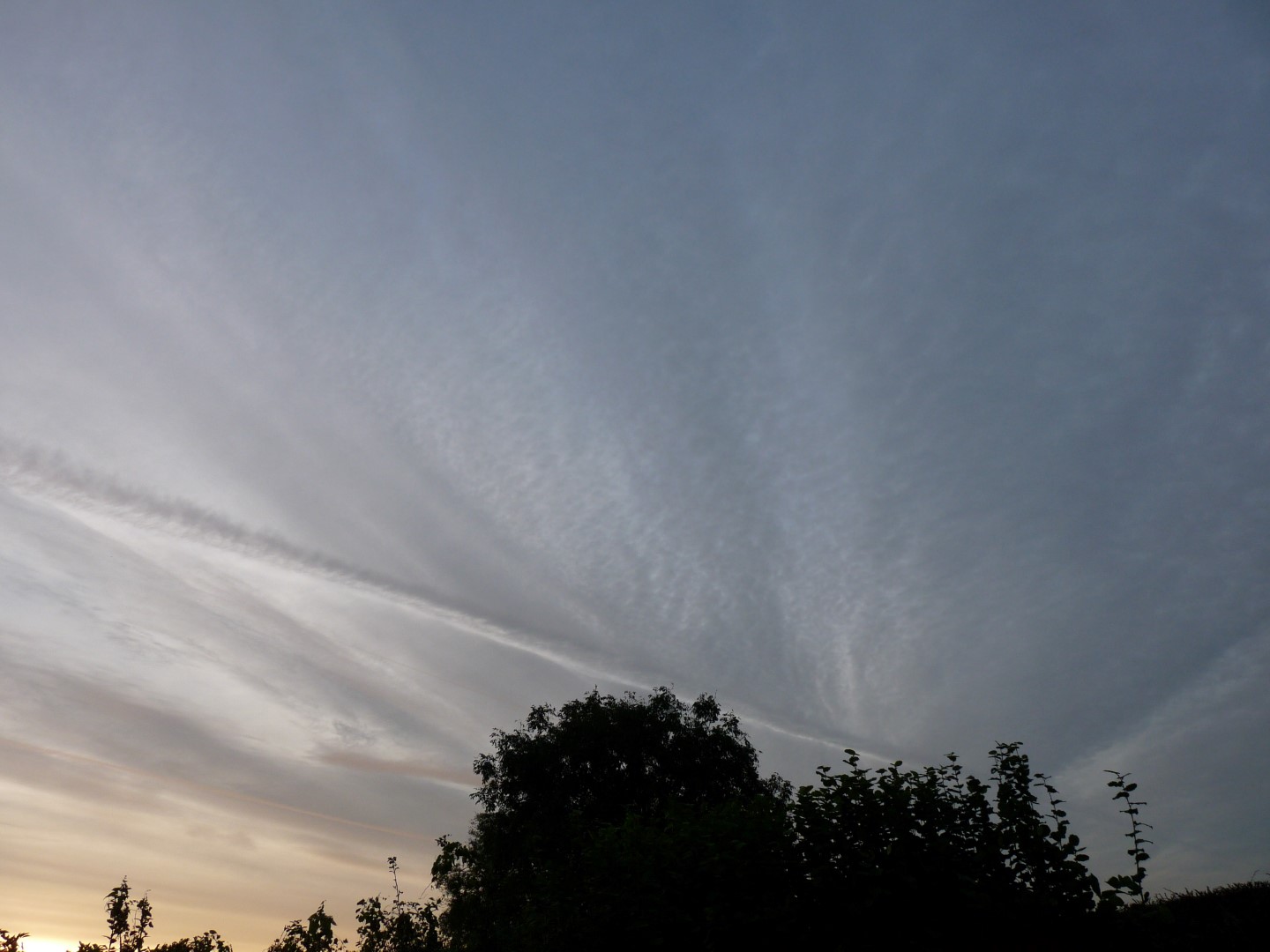
Looking up into the skies to multitudes of passing Redwing heading into their evening roost at Birdy Brow (Kemple End)
Photo: Kindly shared to us by Andy Holden
(Click over the above photo to enlarge)
REDWINGS AT ROOST
I’ve always
had fascinations towards our visiting winter thrushes especially in regards to
Redwing and Fieldfare. I think it could well be that these species in
particular are every vismigger’s dream with visions of the big day movements passing
through their local recording areas.
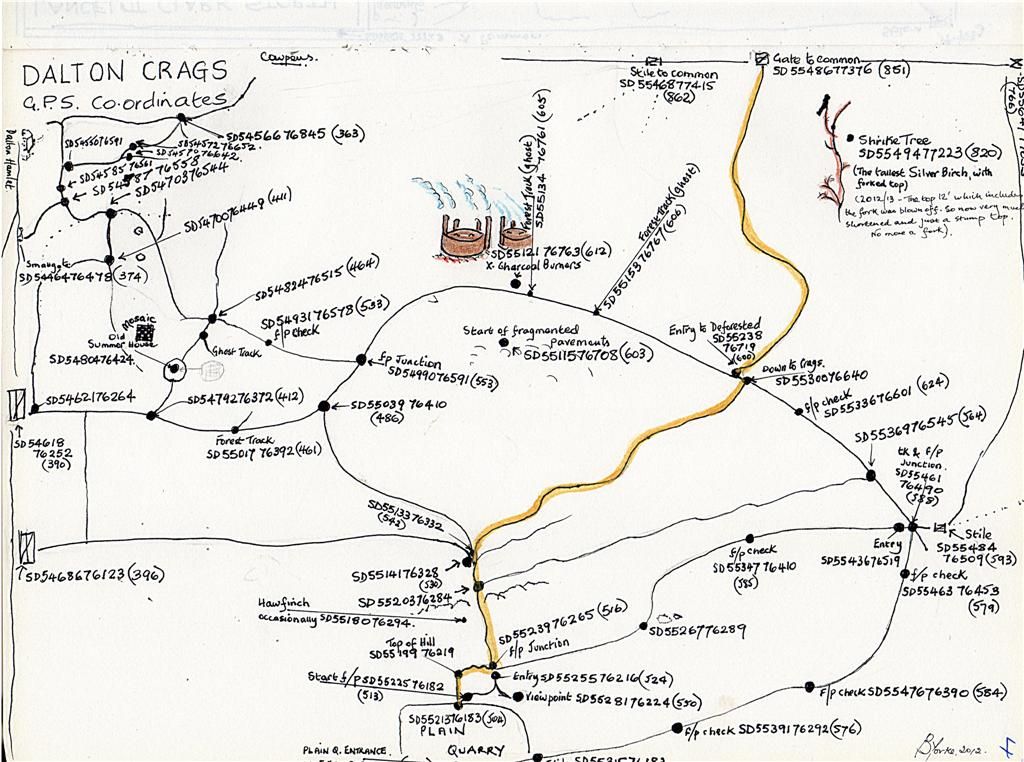
Today I wish to turn to the Redwing and in particular to its roosting records. Once the main migration has started from say the middle of October through to early November, and from then on throughout the winter months, the birds can sometimes be seen roosting on Hutton Roof. If I take the footpath which goes from the Plain Quarry Car Park and up through Dalton Crags there is every chance I may see some of the roosting birds from the previous evening, as a rule I would not expect numbers to be in excess of 100 birds, so I guess in volume “ours” could be considered a small roost.
On another occasion I remember one year following the birds and finding their small roost at the top of Dalton Crags (North West Side) near to the wall boundary with Lancelot Clark Storth. I witnessed them going down into a medium sized Pine tree with a couple more smaller trees close by. I watched them for over one hour and noted that they were restless and moving low all the time from there to other trees perhaps 50-100 yards away and eventually coming back and settling into the Pine Tree. Of particular interest to me was the calls they were making, it was a contact call I had never heard before, which to me seemed totally alien to what you may have expected from a Redwing, more of a gruff sort of call. On arriving back home I searched online the many variant calls and did eventually find the call in question. Sure enough it turned out to be a “roosting contact call” which is only ever delivered at or near to the roost site. I think this particular roosting site was very temporary, and although I did see the same area being used the following year I can’t say I have ever seen it being used since. But I have to say it was lovely to watch even though it may have been of a very small number of birds in this particular roost site.
Another
splendid occasion I would like to recall was on Sunday October 10th
2010. It was 1800hrs and close to dusk
when we arrived at the B.A.P. Memorial seat half way up Lancelot Clark Storth.
Immediately on arrival we noticed large parties of Redwings going overhead,
some really low down, we had no idea how long this had been going on before our
arrival, but they just kept on coming for 35 minutes or so even though it was
starting to get dark. I noticed all the birds were coming in from a SE
direction and making out to a NW direction, the wind that day was East 5-8mph. I
had no idea whether this had been an “all day” movement from the birds, but
considering the time of the day, it did make me wonder if perhaps they were
heading to a roost somewhere nearby! I
went up to the same spot over the next night or two but the situation was never
repeated, so maybe they were just moving through our area. Just for the record
that experience consisted of a Redwing count of 1472 birds in thirty three
parties, with some parties containing numbers between 100 and 170 birds.
A incredible spectacle with 30,000 birds entering a Lancashire roost site
All that may sound good! And yes I feel they are special memories, but let me now try and give my account of just what went on yesterday (18th November 2019). When we were so privileged to witness what must be a very special phenomenom in regards to Redwing roost and because of its nature gave me the inspiration to write this short article.
I would like to mention that this roost has been established from at least 4th November 2019 and possibly earlier! thanks to Pete Morris and his colleague Kris McBride for stumbling on this activity and allowing us all to share the wealth... Also my thanks to Brian Clegg who gave me a heads up on all this...
I guess the
importance of this special roost will be very difficult to comprehend, or that’s
the way I find it. I have never even
heard of a Redwing roost in numbers in excess of the 10k mark. You need to say to yourself where on earth
could 30,000 birds have come from, I would have thought that is about the
amount of birds left within the whole of the UK at any one time and could not
be representative of this local area, but obviously not! Looking at it as logical as I can behold they
must have come from the local surrounding areas of the Ribble Valley and
possibly other nearby areas like the Trough of Bowland, maybe Burnley,
Blackburn, Accrington, Rossendale – who really knows? Does anyone know? For all we know they could have come from even
further afield.
Where on
earth do 30,000 birds hide during the daytime? Surely somebody somewhere should
be seeing fields full of them, or maybe hawthorn trees laden down with them and
what about dusk, will people be reporting seeing such volumes of birds going
through their particular patch? Is there a pre-roost somewhere fairly close and we are missing it?
The true phenomenon just as it happened before our very eyes
The true phenomenon just as it happened before our very eyes
A friend from down in East Lancs phoned me to tell me about a massive Redwing roost site which had been discovered down in the Ribble Valley at a place called Birdy Brow, Kemple End, near Bashall Eaves, an area on the side of Longridge Fell and not far from Hodder Bridge (River Hodder) or the ancient Stoneyhurst or Clitheroe. It sounded really special with reports of over 20 thousand birds going into the conifer roost which to us sounded too irresistible to miss out on. So Sandra and I decided that was our destination, we just had to go and witness this fine spectacle. We were not to be disappointed we arrived on site for about 1545hrs and by 1605hrs everything was in full swing with large sways of birds coming through thick in numbers from a South/South West direction, it soon became obvious we were at the best location to receive the main concentration overhead which was conveniently a small car park, but also the birds were coming through strong at another point almost 100 yards on a wider line to the west, by now the birds were almost just one large continual stream and each second or two saw a hundred or more birds within your single viewing and this just kept building and building in numbers with equal or more continuity, which continued over a period of some 25 minutes or so. I guess there would have been at least thirty thousand Redwing if not more! I know that sounds incredible numbers for thrushes, but sure enough it happened before our very eyes. Also we noted up to 30 or so Blackbirds which sort of flew just slightly beneath the Redwing flock and I am sure there would also have been hundreds of Song Thrush as well within the massive flock and guess what? There was at least one Peregrine in sight at times spooking the Redwing before all went quiet, and probably a sign he must have got his supper! There were also other birds of prey lining up for a piece of the action which included Sparrowhawks, a couple of Buzzards as well. This today was something really rare and special and I believe this roost has already been going on for several days now……Just a bonus or what! but has the Redwings started to thin out at a point of almost darkness, a few Woodcock were seen coming out of the areas close to where the Redwing were entering, obviously leaving their daytime roost to go foraging and we witnessed at least 8 birds but I am sure this would have been well under estimated.
Site visits (Monday 18th, Friday 22nd and Friday 29th November 2019)
I again visited the site on Friday 29th November 2019 (my third visit) and got there early so I could take a few photos of the area and map out the actual roosting areas. Check photos below. It had been a clear day with dying blue skies and very cold, so maybe if anything the birds started coming in a little later, but the main activity was going strong by 1605hrs and continued through until at least 1630hrs. Prior to the Redwing coming through I noticed up to a score of Chaffinch also using the roost, these came through in dribs and drabs (mainly pairs). We had a good showing of the Redwing but if anything for me maybe a little subdued in numbers compared to my two previous visits. Also it was clear to see that the birds were more biased to the South side of the car park (far more so than usual). Another fine spectacle to finish off with was seeing up to 12 Woodcock leaving their roost on the edge of darkness.
Other interesting reports
A friend went to observe the following evening (Sat Nov 30th 2019) and reported that numbers seemed to be back to normal (30k) and the approach over the car park resumed to its best observation flightline! - More interesting updates below:
27th November 2019 by friend Michael Finch who quoted to me "Earlier today I was in the South Lancs making my way back to Ribchester via Salmesbury. At about 3.10pm several small groups of Redwing (70-100 per group I'd guess) moved across the fields in the general direction of Longridge Fell, several miles away but visible. I drove straight to Kemple End and sure enough at about 3.45pm Redwings had started to come to roost. Of course they may have been a different group. They still seem to be coming through in large numbers.
I am informed that recorders had over 36,000 Redwing coming in to roost at last nights count (Sat 14th December 2019).
Saturday 14th Dec 2019 - ROOST NOW AT approx 6 WEEKS OLD
I am reliably informed that recorders had approx 60-74,000 Redwing coming in to roost at last nights count (Mon 30th December 2019) - "Andrew using a clicker, averaging 100 Redwing every 2 seconds which went on for 21 minutes. We already had 10,000 earlier before the main rush and Andrew gave a total of approx 74,000" whilst his friend Simon Warford confirmed 60,000 birds.
Tuesday 31st Dec 2019 - 27,000 approx going in to roost as recorded by Mark Breaks (ELOC website)
Saturday 4th Jan 2020 - ROOST NOW AT approx 9 WEEKS OLD
Saturday 4th Jan 2020 - Simon Warford and Simon Johnson recorded approx 44,000 Redwings coming in to roost.
Saturday 18th Jan 2020 - 15,832 birds approx going in to roost as recorded by Gareth Morgan (ELOC website)
Sunday 26th Jan 2020 - Margaret Breaks (ELOC website) reported as follows: "Still at least 10,500 Redwings came in to roost at Kemple End tonight, although they are getting later, with only around 350 in by 1645hrs, and then a steady stream until after 1700hrs. A Peregrine and several Woodcock were also seen.
Sunday 26th Jan 2020 - ROOST NOW AT approx 12 WEEKS OLD
Saturday 1st Feb 2020 - Recent reports from ELOC are suggesting there could still be around the 25,000 birds at the roost..
Probable part DISPERSAL from roost around mid January
It looks very much like there could have been some dispersal of birds sometime during the period 4th January 2020 (44,000 birds) to 26th January (10,500 birds).
Friday 14th February 2020 - 5000 birds recorded at dusk - (Margaret Breaks ELOC)
Friday 28th February 2020 - Only 15 Redwing and 6 Blackbird recorded at dusk (Margaret Breaks ELOC)
Will the roost remain throughout the Winter?
Will this roost carry on for the full length of the Winter months? Whilst at Kemple End the other evening I was told by a gentleman (a retired ringer) that he used to regularly check out a redwing roost site at a Garden Centre, down in Bury, Greater Manchester many years ago and that particular roost had up to 10k of birds coming in nightly and continued to last for the full length of Winter
Do you think perhaps the terrific berry yield this year especially with the Hawthorn and the Holly may play some part in the extroadinary numbers of birds still hanging about this year and in turn having something to do with the high numbers at "Kemple End" roost ?
Roost awakening!
Would it again be such a spectacle to see the birds leaving the roost, early morning, yes it would! although going off the experiences I have had with the smaller roost, the birds (Redwing, very much unlike Starling) don't usually leave the roost sites in one go! whereby they leave the roost in smaller parties and the vacation may take up to one or more hours, I just wonder if this is similar with these massive roost.
Redwing - substantial historic roost records.....
In late November 2009, it was estimated that 60,000 Redwing were roosting in Broomy Enclosure (New Forest), whilst in late 2010 - 15,000 were recorded flying into Long Beach Enclosure. (information from: New Forest Explorers Guide)


Further information gathered from my 3rd visit on Friday 29th November 2019
(Click over photo to enlarge)
Shows a rough guide to the approach of the Redwing which come over the Car Park
areas and closeby, although a lot of the birds also approach for several hundred yards
to the right hand side of this photo

Further information gathered from my 3rd visit on Friday 29th November 2019
Click over photo to enlarge
Here is a continuation of Roost area 2 showing the immature conifers to the RH side
of the road, and shows the area Roost area 3 within the block of mature conifers
which lie almost to the rear of the old quarry 75 yards to the W of the car park

Further information gathered from my 3rd visit on Friday 29th November 2019
Click over photo to enlarge
This is a view looking directly South from the Car Park and the birds are
roosting in the large conifers to the LH side of the road (Roost area 1), and also the
birds are roosting in the smaller immature conifers to the RH side of the road (Roost area 2)
Can be seen soon on BBC Winterwatch
The spectacle was filmed on selected dates between the 20th - 30th November and I do believe they got some good shots which can be seen on BBC "Winterwatch" transmission date THR JANUARY 30th 2020 at 2000hrs....
Great to get on the credits with the Winterwatch for helping with the Redwings

CLICK THE ARROW BELOW LEFT HAND SIDE TO HEAR THE RARE REDWING ROOST CONTACT CALL......Please make sure your speakers are switched on!
This is a fabulous little video posted live this evening by Craig Bell of Rossendale showing the Redwings on their way into the roost in Kemple End, (Ribble Valley) Lancs. Tuesday 19th November 2019 (approx 1600hrs). Please click over the arrow....
Run your courser over the photo and then click the square that comes up to enter fullscreen......
also click over this to enjoy a fabulous short film by Margaret Breaks of the Redwings

Redwing feeding
Photo: Kindly shared to us by Craig Bell
 More (Birdy Brow) Kemple End - Redwing roost photos
 More (Birdy Brow) Kemple End - Redwing roost photos
 More (Birdy Brow) Kemple End - Redwing roost photos


________________________________________________________________
Although the roost did start to develop in 2020 with a few hundred birds, it quickly dispersed in late October with very few birds recorded. This year in particular has been such a poor year for berries.
_________________________________________________________________