Tuesday, 23 February 2016

GOLDCREST calling from Burton In Kendal and also Nr. Abbots Hall Play area in Kendal


Song Thrush singing away with occasional Trimphone noises  (Click over to enlarge)

Tuesday February 23rd 2016

Last few days have been out over Dalton and Lancelot with very little to report other than singing Song Thrushes at quite a few locations. Some lovely song being sung.  One bird in particular was mimicking telephones!  had this many years ago in Lancelot...

Today was nice and sunny though cold at first, but birds where singing away everywhere.
First time this year had Goldcrest singing - One on Slape Lane and then later two chasing one another in Lancelot Clark Storth.  Also had more this afternoon in the large conifer just by the Cropper memorial stone by the Abbots Hall Play area on the side of the River Kent. Wonder if these are passing birds or local breeders.  This is exactly the time of year when you get a lot of passing through birds.

Friday, 19 February 2016

The Epic of Hedgehog Noah and the Great Flood by Titus L c2016


Photo: Titus L


Hello, I thought you might enjoy my poem about a hedgehog that survived the floods of Kendal December 2015. by TITUS L.


The Epic of Hedgehog Noah and the Great Flood


Here's a tale of true Cumbrian spirit,
Of a Hedgehog with fine character and distinction and merit.
It all happened in the winter time not too long ago,
In December through February before coming of snow.

Infact it began with the most terrible floods,
When Cumbria submerged under Storm Desmond' scuds -
And half the wide world - well, of North England at least,
Below waters submereged, South England slept till it ceased.

As days rolled into nights and weeks into wondering,
The good people of this land united despite political blundering.
And many sorts of care they sent from kind hearts everywhere -
To help with housing and drying, heating and eating prepare.

To restore businesses and byways and bridges - those needing,
But not much thought in this time for our wildlife or its feeding.
Creatures and living things suffered the unspeakable end,
Swept across counties and fields, beyond life sadly transcend.

For the wild animals- birds- insects, the flood was a calamity...
Indiscriminate death struck beak-claw-wing, web and anttenaey.
Apocalyptic and Biblical in potent and style,
The preeceding rains saturated everyones mile.

Forty days, fifty nights and countless many more,
Torrents of heavy waters did relentless downpour.
That fluminous floodtide flyped our commonweal to extinction,
Its like was unseen despite the hydrologists prediction.

Plunging upon us without warning or caution,
No shape of its own nor a pause to its auction.
As the offspring of El Nino, of climate change and plutonium,
Outbid itself onward in joyless wetdrenched pandemonium.

Natures Judgment rained heavy that night on the land,
For mankinds environmental havoc unplanned.
Sparing neither sacred space nor people's public ground,
Greedily the flood waters raced all around.

Global warming the cause for those who can see,
Of cataclysmic upheaval in Gulf Stream - like a banshee.
Creating a convocation of waters finical in their fury,
Falling, swoosh-galling in their appalling abjury.

A Hedgehog hidding from somwhen waterish did declare,
To the welkin above, his will to survive overcoming despair.
'I call to you to stop your heartless cold waters',
He cried out as he swam, rushed and burrowed to new quarters.

Underneath waters and waters and wetness without end,
He swept swiftly down rivers that on his life did intend.
Calling in alarm to the dark minister of the storm,
He hooted and honked - across Fell lands he swarmed.

Past sodden amphibians and limpid land dwellers,
For dry land Hedgehog paddled, with his propellers.
Past Neolithic Shap to Kendal by Kent,
Hedgehog found a hillside to hang on to, his energy spent.

Eventually the raw raintide did lessen its beratement,
Of splashing relentless - at long last an abatement.
And in the stunned silence as waters backdated,
Fellow voyagers across land found themselves translocated.

In the silt slurried earth where we all make our home,
Every creature now surviving went out to roam.
Amidst this sodden turmoil the Hedgehog scurried forth,
And found a wooden shelter in our garden, west by north.

As covenant storms were over, a rainbow raised high,
Resplendant and bright in the returned new blue-sky.
And in his shelter, lets call it an Ark for the moment,
The Hedgehog's name became Noah, for Natures atonement. 

Nocturnal in his new home Noah sings beneath the moon,
Softly and gentle of the earth and the wonders unknown.
His breath is quite gaspy and tuneful - if not musical quite,
Noah's the epitome of Cumbria - he's doing it right.

c.Titus.L. 2016
More information here
http://tinyurl.com/h8p8t2s
Best Wishes

Titus

Thursday, 18 February 2016

February's charactors may include Larks, Throstles and Shrikingly Good


Hazel = Dormice (or dormouse!)
One of the labels for my agenda this year
Last year seen in Hutton Roof village,
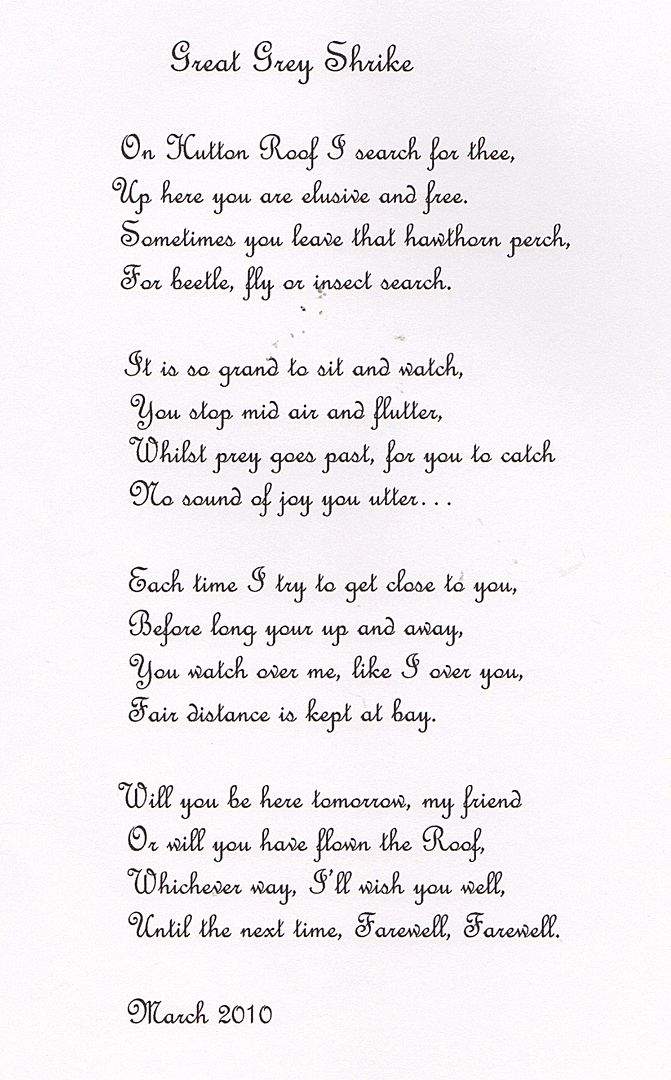
This year I will search out the great Lancelot,

The Lark has given a Valentine’s treat,
From high so high and sometimes out of sight
He’ll sing away with all his might, our dear SKY!
A name fit for Dalton’s annual first returning Lark

By the middle of February the Throstle will sing,
From the top of his highest tree he’ll bring,
“Wee hoo whit” and “Her Kleep Kleep” and,
A patchwork song fit for a King.

March 7th can be a very good date indeed!
A “shrikingly” good day according to records past
He’s already impaled my mind with brutal shots
Of haw larders full of “Butcher’s” past plots!

Searched and searched for a “Duke” no more,
Amongst Primula’s smiling sunshine faces,
Other fluttering fritillaries will take to the air,
In fast flittering flight to wander their fair…

On May’s first Sun, they will ascend the Crags,
To hopefully hear the first Cuckoo’s call,
It’s become a tradition from many years past,
To seek the Cuckoo’s syllabilic echoing call


18th February 2016

Wednesday, 17 February 2016

The Resting Swans have not migrated just yet!


Had lunch today with the "Resting Swans"  (Please do allow your (migration) - sorry I meant imagination to wander if just for that short period! mine is not set in stone just yet, is it!) 
(MORE NATURAL SCULPTURES I FOUND - CLICK HERE)

Slightly from another angle - taken on 27th June 2012 - note the front Swan the head and neck comes in from the left hand side compared to the above which is coming from the opposite direction.  A mirrored image must be ruled out because the Swan in the background is almost the same position in both photos - how could that have happened? WOW MYSTERIOUS YOU MIGHT SAY!

Reports for Monday 15th and Tuesday 16th February 2015 - Dalton, Hutton Roof Common and Lancelot - 

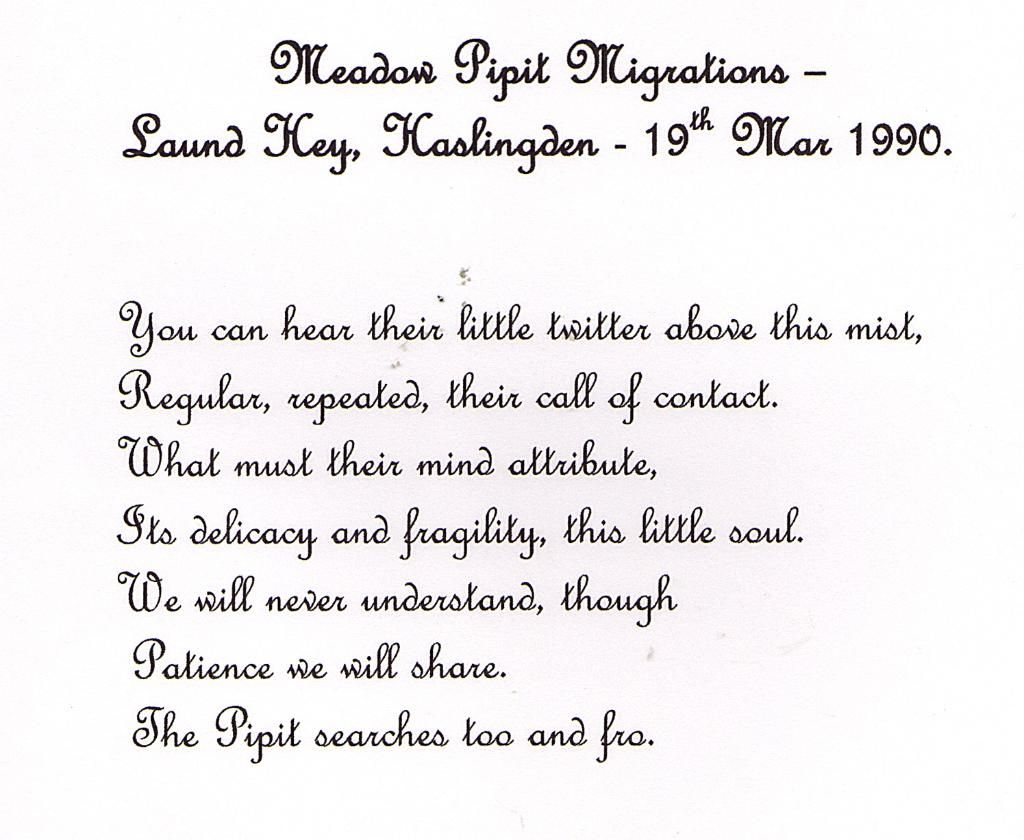
This cold spell certainly put paid to the Skylarks and Mipits, not seen any up on the Roof since the 15th, probably all gone back to the coast if truths known!

Even the Song Thrushes have quietened down a bit!  But just one still went for it with (over 10 minutes)

Hoo whit,
Wee woo, wee woo,
hoo whit, hoo whit,
chereek, chereek, chereek,
witty woo, witty whoo,
ker poo, ker poo,
weehi, weehi,
Trough eh, trough eh (fast and in trill)
(Part Curlew intro call),
hooit, hooit, hooit,
kitti-zay, kitti - zay

and lots lots more, but my shorthand today was very limited and he was singing a lot faster than I could write it down, so I will get some more hopefully over the next few days.

The regular pair of Stonechats are seen on both dates in the Dalton deforested (just higher than the line of trees but below Wheatear Plain and sometimes further up near the "Gully". Three Mistle Thrush also present in this area. One Green Woodpecker flew across towards the Cuckoo tree.

Look carefully at this photo and what can you see?

Fresh looking yet damaged "Aculeatum" from last year seen on Hard Shield Pavement 16th Feb 2016)
Also found what looks like evidence of Common Rock Rose and not far from the TRIG, but we will have to wait and see.

**********************************************

Saturday, 13 February 2016

SKYLARKS AND SONG THRUSHES - EARLY THIS YEAR!


Report for both Wednesday February 10th and Friday February 12th 2016

What a cracking day! dry at last with blue skies, they say what a difference a day can make.  Looking everywhere for those elusive Hawfinches nibbling the uppermost veins of the old tall beeches just after leaving the Plain Quarry.  But none to be seen, its a rare occurrence we get those big beautiful finches perhaps twice a year if I am very lucky. This area at this time of year is usually occupied with scores and scores of mixed finches and tits, but noticed this year a absence, just like it has been with the Thrushes.  In most years during the Winter months we have at least 50 to 100 mixed Fieldfare and Redwing on Hutton Roof, but this year their absence has been well noted.

(SONG THRUSH) So what could stop me in my tracks?  well none other than at least three "throstles" in full song from the high points with lots of fascinating song of love.  Starting off with the regular "Wi hi Woowit, Wi how wi, Brig ga deer (thats a new one for me!), "Was hay, weehay woo", "Che er dee", "Hello-di", Hello - di"  and lots lots more. So special are these sounds today and usually for me its the signs of another start to the year. Must try and get out regular to record these fabulous calls.

(SKYLARK) Nah then! it must be the earliest ever for me - Wednesday February 10th 2016, I had just about got into Dalton deforested and sure enough very faint could hear "SKY" the lark singing happily away in the distance.  Eventually seen to come down on to the boundary wall.

A couple of days later - Friday February 12th 2016 whilst heading over "Uberash Breast" I was drawn to the skies to witness 8 Skylarks calling whilst on their way directly heading South. Why South?  It appears strange but I had the same thing a few years ago whilst having a walk over "Cumswick Scar" when then also a small early party were heading South. So for sure the Skylarks are definately on the move.

(MEADOW PIPITS) Just odd ones can be heard going overhead and occasional singles on the more open ground.

(GREAT TITS) are also in song now with some very monotonous recurring calls amongst its most beautiful repertoire.

(THRUSHES) Still very thin on the ground and very luck to see a small party of 8 Redwing crossing over within Lancelot Clark Storth.

(CHATS)  Again the pair of Stonechats have overwintered with us on Dalton deforested and were present again today.

(PECKERS) I did hear the call of the Green Woodpecker, but had three different Great Spotted Woodpeckers drumming away in Lancelot with two of them obviously responsive to one another.

(WOODCOCK) Still flushing the odd Woodcock on Hutton Roof, but the Snipe seem to have dropped off for now.

On Wednesday it was nice to meet up with friend and fellow naturalist Robert Ashworth from Kendal, and I enjoyed showing him the Green Spleenworts and the Holly Ferns and the spectacular limestone pavement with the sinkholes.

Robert Ashworth at the Trig Point


I spent some time checking out various blocks of pavements searching around for Polystichums and Aspleniums, but nothing much new, though (jokingly!) I think I may have come up with a new species and its called the PURPLE SPLEENWORT.

"A Maidenhair Spleenwort from 2015 and now tinged with Purple" (Click over to enlarge)


Friday, 5 February 2016

Another one of the Gems of Hutton Roof - "SINK HOLES AND ANCIENT RUNNELS"


Dave Barker and I over on Newbigging - Farleton

It was great to get out and about again yesterday, and especially to finally meet up with Dave Barker who had joined me all the way from over in the "White Rose" County (Oxenhope).  Dave is another guy heavily involved with the Visible Bird Migration Studies and was one of the founder members of the Vismig Recording Group.  I have spoken regular with Dave for many years but never until today actually met him in person.

So it was great to actually show him the areas I use for my vismig counting here on both Farleton and Hutton Roof, whilst at the same time being able to show him the rare Holly Ferns together with Ceterach and other aspleniums, and a very special geological "Gem".

Birds today were a little quiet although we were treated to magnificient close up views of the Woodock over on Farleton and close to Newbigging. Obviously the bird had been flushed and took off nearby and circled directly above our heads with clear views of the bird.  Also the Green Woodpecker was heard yaffling away in the distance.  Its rather early for vismig and I did not expect to actually see or hear birds on the move, but it soon became apparent that we had several calls from Meadow Pipits which were grounded and put this down perhaps to the mild conditions.  In fact thinking about it I have also had odd single birds over on Hutton Roof during December and January which now I am thinking will have over wintered with us.

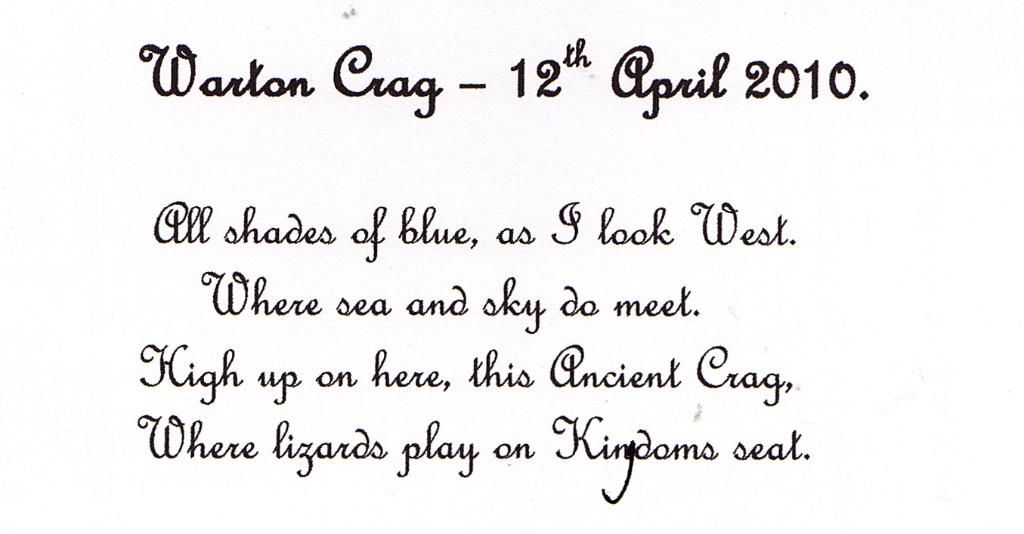
I knew I was in the right company for it to be well received and had in my mind prepared a "special treat" for Dave to check out a little gem of a pavement which we have on the Roof which has many "sink holes" and beautifully patterned runnells running throughout.  It was great to see someone specially enjoy these features and quote in his words "this has to be one of the special wonders of Cumbria" and yes I had to agree with him whole heartedly.

A couple of photos here showing that very special place. (photos taken back in September 2013)


The above three photos were taken during September 2013


And above is a photo taken on Wednesday Feb 3rd 2016 with Dave next to the large "Sink Hole"


Finding this well hidden pavement was such a surprise, and it
reminded me (and others) of a turbulent sea.  And so the little poem is about
leaving the Trig Point on Hutton Roof and giving the directions
in "nautical" to try and find that "Raging Sea". (9th Sept 2013)

"To find the Raging Sea with swirls and black holes and all,
Then leave the rig, and head Norwest, you must look starboard,
And follow below those white clints.
And soon you pass that bouy upon your port side,
Soon after, you steer port side and follow the rugged contour,
Clear the headland and on the swing around you enter,
That Secret sea of Raging grey with sinking Black Holes everywhere".


If you want to check out more photos of this little gem of a pavement then please click here (external photo hosting site)

Tuesday, 15 December 2015

Another rare Asplenium Scolopendrium Crispum ..............?

Wow! just cannot believe what I found this morning in Dalton Crags, yet another of the mega rare Asplenium Scolopendrium Crispum........? variety of Harts Tongue Fern, all three have been different.  Here is a few photos of No.3 which I found this morning.

 Base of frond - another different arrangement  (Click over photo to enlarge)


 Rear of Frond  (Click over to enlarge)


 Showing a nice frond   (Click over to enlarge)


Scolly - Crispum - Group - full 3 fronds  (Click over to enlarge)

Although I am out most days looking for ferns I really did not expect to find yet another one so quickly.  I suppose the "rarity" value is diminishing by the minute..  But seriously no it is so rare as the norm!  

Again this one is so different to the two previous and does have its own features especially so at the bottom of the frond.

To check out all the photos of Crispum Group No.3 (temporary name for now) PLEASE CLICK HERE and select first photo, then go to right and click through them.  If you want to enlarge go to top right corner and click on the magnifier.

To check out all the photos of Crispum Group No.2 (temporary name for now) PLEASE CLICK HERE and select first photo, then go to right and click through them.  If you want to enlarge go to top right corner and click on the magnifier.

Photographs have already been sent to Alec and other Fern authorities and awaiting their resolves.


Friday, 11 December 2015

Another Scollie! another fabulous 'Crispum Group'


The above photos are showing the rare fern at variant distances in situ

Rear view of the fronds - showing no sori and confirming crispum variety
  Click over to enlarge


Just can't believe I could find this rarity today, its another "Scolly" and this time its another of the rare variants "Crispum Group" with the Queen Anne (Ruff) look. Not quite as nice as Alec's earlier find but certainly worthy of the same "agenda" in fact this one could well turn out to be "fimbriate" according to two experts.

This one is slightly down a limestone gryke which does afford it some shelter on Hutton Roof Common.

Found lots of "forked" scollies in and around the same area and checked out the "Ramasum" and also the Southern Polypody which I found last year. Lots of Trichomanes look interesting!  I had one in particular which was coming from the rootstock of both Maidenhair and also Scolopendrium.  It looked quite large pinnae and I thought best to take a sample just in case (see photo below).  But I suppose if I was to really get into it I would never get anywhere because there can be something just slightly different at every turn!  so to a degree I need to be a little selective so we can at least then progress to cover some ground.  What I am trying to say is that everytime you go out its so rewarding and if your in the right mindset you are getting a massive treat everyday (well almost).

They do keep telling me that when you get a basic knowledge of the ferns and learn to "get thi eye in" that it becomes easy peezy - well I am not sure about that! but what I am sure about is that it is a great adventure which keeps building as everyday passes.  I love the search, the find, to photograph and then to be able to write about it, and record it and to have that great opportunity (thanks to Google) to `share it all with you

Maidenhair Spleenwort (asplenium trichomanes) (Click over to enlarge)
A little dry on photography but still shows the enormous pinnae sizes of this specimen which came directly out of the same root stock as a scollie! It certainly looked well unusual to me!


Another one of those Polypodys!

Wednesday, 9 December 2015

Green Spleenwort (asplenium viride) photo comparisons etc


Shows the flooded Mosses with Arnside Knott in the background - photo from Lancelot Clark Storth  (Click over photo to enlarge)

It has been a historic week with record amounts of rainfall throughout our area and the Cumbria area as a whole. Temporary Tarns have been turning up everywhere. So much is currently under water. I took the above photo looking towards Arnside Knott and the Hale Mosses to the West from Lancelot Clark Storth.

I managed to check out Hutton Roof yesterday (9th December 2015), firstly checking out all the sites for the Great Grey Shrike, but nowhere to be found, which more or less indicates that he has not arrived so far this year!  I have also noted this year he is also absent as yet from his other Lancashire stronghold sites at Waddington/Stocks areas.  The only birdlife this morning was a accidentally flushed Snipe and also a Woodcock.


Showing variations of fronds of the Maidenhair Spleenwort (asplenium trichomanes) - all taken at G2  (Click over photo to enlarge)


I did some Asplenium and Scolly searching and was able to relocate some Green Spleenwort (asplenium viride).  It was good to see that both clumps at this site are OK and I have taken a photo (shown below) which shows the type of habitat the (rare for these parts) viride seems to like, the damp sides of open grykes.  Also I managed to get a photo which includes a Maidenhair Spleenwort (asplenium trichomanes) which allows good comparisons between both of the separate species.  Can never help but show interest towards to great variation in some of the fronds.  I have here also included a photo showing how much variation there can be amongst the fronds with the viride species. I am surprised to see just how good the fronds look for this time of year!

This photo shows both Green and Maidenhair Spleenworts in situ and allows good comparison between both species  (Click over photo to enlarge)

I have so far been able to locate 13 clumps of viride at three separate locations over a total area of approx 300 square yards outside of this local area I have has yet not been able to find anymore. They specimens are at a altitude of approx 850ft above sea level and just under the height of the nearby Trig point which stands at (900ft approx).  The species is extremely rare in these parts although I believe more common to the Eastern side of the County.

Also I found a new area showing some nice Harts Tongue Fern (asplenium scolopendrium) variant "Undulatum" and here is a photo of it peeping through the base of a hazel.  Just could not get access any closer because of the tree. Also closeby (within one metre) I noticed some Polypody which at first glance looks very much like a Southern Polypody (Polypodium cambricum), although this cannot yet be confirmed without spore analysis.

Close up of the Green Spleenwort  (Click over to enlarge)
Harts Tongue Fern  (asplenium scolopendrium - variant Undulatum) - (Click over to enlarge)
I am quite confident it will turn out to be a Southern Polypody  (Polypodium cambricum) (Click over photo to enlarge)

Tuesday, 1 December 2015

Checking out Aspleniums


Monday 30th November 2015 - Dalton Crags  (1400hrs to 1600hrs)

The weather was atrocious earlier but did manage to get out between 1400hrs and 1600hrs to check the area of the escarpment (Rockcress Escarpment).  A couple of things of note are as follows.

Checking out the Asplenium Trichomanes (Maidenhair Spleenworts)  In one particular area and tucked away in the shade of a cleft within the escarpment, and a area damp with dripping water it was quite noticeable that the fronds of the plants were much larger that the normally typical Trichomanes we have come to expect.  I have published a photo here to show the comparisons.

Maidenhair Spleenwort  (asplenium trichomanes)
1 - Top: Standard average size of the plant. 2nd, 3rd and 4th down: Showing the sizes of the fronds (much enlarged) I found under the cleft of the escarpment.
I can only put this enlargement down maybe to being in a area which would be far more moist and also a area receiving more prolonged water feed during rainy periods, I have no other explanation to offer.

Also whilst out this afternoon I was able to find a large Harts Tongue Fern (asplenium scolopendrium) with a forked frond as follows:

Harts Tongue Fern  (asplenium scolopendrium)
Unusual to see the frond forked at the top
Also found some more Polypody which I do think could well be the rare Southern Polypody (Cambricum) pictured below:


Thursday, 26 November 2015

Green Spleenwort - Asplenium Viride - Normal and Different!!


Thursday 26th November 2015 - Dalton Crags and Hutton Roof Common

I set off again today to see if by any chance the Great Grey Shrike had returned, but I searched everywhere in his normal haunts without any success. In fact very little in the way of birdlife other than a roving party of about 15 Fieldfare and later another party of approx 30 birds. A single Stonechat up near the gully in Dalton deforested.  And some Goldcrest were heard near the Trig point.

So I thought its time I checked out the Green Spleenwort populations at G3 and I counted eight separate populations (one population up on 2014). But for some reason my eye caught one particular group which did seem to have different fronds to the others and also the pinnae and sori looked different.  You can see from the photos below there is a clear difference.

Green Spleenwort - asplenium viride  (Click over to enlarge)
1) top: Green Spleenwort - normal, 2) middle: Green Spleenwort with a difference  3) closeby within one metre Maidenhair Spleenwort (asplenium trichomanes)

It was necessary for me to give the items more exposure than I would have liked but it was the only way in which I could express the light and at the same time keep out any shadow.


Green Spleenwort - asplenium viride - rear frond (Click over to enlarge)
1) top: Green Spleenwort - normal,  2) middle: Green Spleenwort with a difference, 3 bottom:  closeby within one metre Maidenhair Spleenwort.  
It was necessary for me to give the items more exposure than I would have liked but it was the only way in which I could express the light and at the same time keep out any shadow.


Wednesday, 18 November 2015

Harts Tongue Variants and Southern Polypody (18th/19th Nov 2015)


Sunday 22nd November 2015

Found another new to me Scollie variant in Dalton Crags today and here are the photos below:

 Looked interesting especially with the curvatures


This shows the same plant with two similar fronds the one at the top and another down at the bottom of the photo. 

Also of interest to me today was my find of a strange Maidenhair Spleenwort (asplenium trichomanes) shown below:


Unusual trichomanes

This was in a damp darkened cleft of the limestone escarpment and actually hidden behind some normal Maidenhair Spleenwort and mosses and herb robert (central), but if you look closely you can see the lobed spleenwort lurking.  I have gps'd and will be keeping a close eye on this. By the way within less than one metre is a good population of Wall Rue.

*****


Thursday 19th November 2015

On the Bird situation.  I had a small five party of Siskin calling and flying above the large trees on the edge of the Plain Quarry car park.  Also had 4 Mistle Thrushes at the top of Lower Dalton Crags. One Green Woodpecker crossing Dalton deforested.  Also two Snipe flushed just east beyond the Trig Point (Ploverlands). Robert Ashworth also had a single Goldcrest near Plain Quarry this morning. Had a good look around for a Shrike, but nothing doing at the moment.

This morning whilst on my way up through Dalton Crags I again found yet another Harts Tongue Fern which was different to the norm and looks very interesting. At first viewing I just thought the serrated edges were a weather worn situation, but on closer observation, you can see that they are a purpose natural occurrence on this specimen, which is confirmed by the representative individual veining pertaining to each serration, and you can see it here in this first photo.  Here are the photos:


Harts Tongue Fern with serrated edging  (Click over to enlarge)


Wednesday 18th November 2015

What miserable weather!

I have been out over the past few days at various times when it was not too bad and seen one or two bits and pieces of fungi and ferns.  So here are my findings:

Harts Tongue Fern  
It certainly gives the appearance of difference! especially noticeable in the front central frond (also shown below) and its appearance in general stands out from the "norm".  Another interesting indicator was that the fronds did not bear any "sori" on the rear side although the frond lengths (approx 10-12") seemed to be of maturity.

Showing a clearer photo of the main frond


This photo gives a better view of one of the fronds which has a "lumpy" make up.

Rear of the frond showing a lack of "sori"


Also whilst out yesterday I found some more of the rare Southern Polypody (polypodium cambricum) in a new area of Dalton Crags and will obviously inform the County Recorder.  The area shows quite a few specimens over a approx area of one metre diameter.

Now then I do have a cracker here but its been very difficult to photograph, but hopefully I can give you some idea.  Its a "deformed" Harts Tongue Fern and actually does have 5 separate heads to the frond (of which two of the heads do contain Sori).  Its hard to show because of the entanglement but really interesting.  Also a similar occurance but to a lesser scale was also happening with another frond within the same group (see photos below)

This shows the deformed Harts Tongue fronds in situ (note x2)  (Click over to enlarge)

I have attempted here to separate the five heads  (Click over to enlarge)
Showing the entanglement in situ - also note behind frond  (Click over to enlarge)
Showing the rear with Sori on two of the heads  (Click over to enlarge)
There maybe some more stuff to add to the blog later so please try and check out again if you can later.